SHOWGIT은 체스와 비슷하며, 어떤 사람들은 전통적인 체스 변형 중 가장 복잡하다고 생각합니다. 근본적인 차이점은 말을 잡았을 때 상대편을 위해 보드에 다시 들어갈 수 있다는 것입니다. 이것은 SHOWGIT이 무승부는 다행히도 드문 이벤트라는 점에서 다른 형태의 체스에 비해 큰 이점을 제공합니다.
설비
SHOWGIT 게임은 81개의 사각형(9 x 9)으로 구성된 보드에서 진행됩니다. 각 플레이어의 조각은 다음과 같이 구성됩니다.
- 9 UNIFORM (폰과 같은)
- 2 LIMA (랜스처럼)
- 2 양키(나이츠처럼)
- 2 알파
- 2 마이크
- 1 VICTOR (비숍처럼)
- 1 탱고 (루크처럼)
- 1 STAR and TIME (like Kings)
조각은 모두 같은 색의 평평한 사각형 모양의 카운터입니다.
조각 목록 (앞뒤 회전 GIF)
-
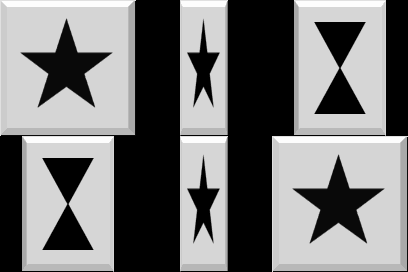
STAR / TIME (프로모션 없음) -
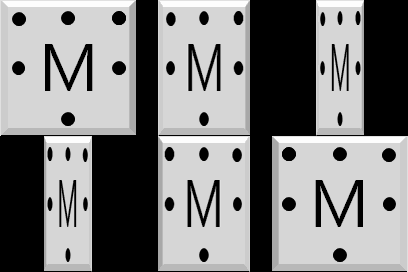
MIKE (프로모션 없음) -
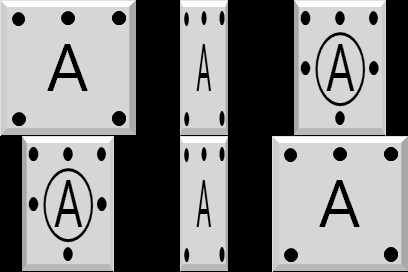
알파 → 네오 알파 -
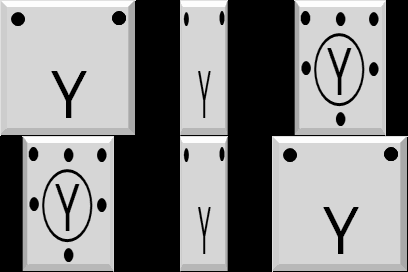
양키 → 네오 양키 -
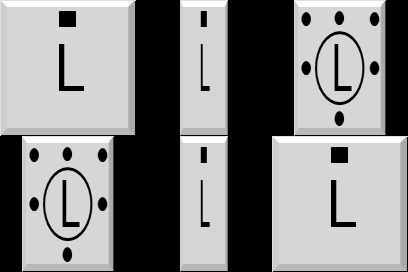
리마 → 네오 리마 -
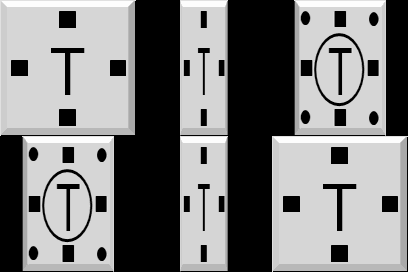
탱고 → 네오 탱고 -
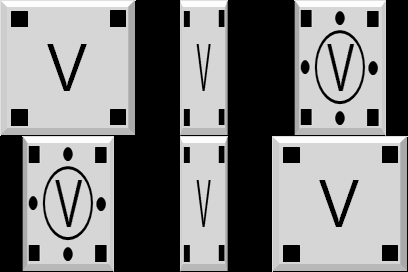
빅터 → 네오 빅터 -
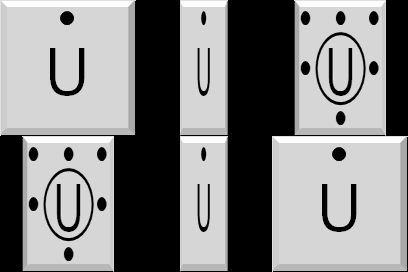
UNIFORM → 네오 유니폼
Preparation and Objective
Each player's nine UNIFORM are placed on the third nearest row to the player. The TANGO and the VICTOR are placed on the second row one space in from the edge, the TANGO on the right, the VICTOR on the left. The remaining pieces are placed on the row nearest to the player in the following way: the LIMA in each corner, the YANKEE on the next square in from the corner, the ALPHA next to the YANKEE. The middle square on the nearest row holds the STAR(or TIME)with the MIKE either side of him.
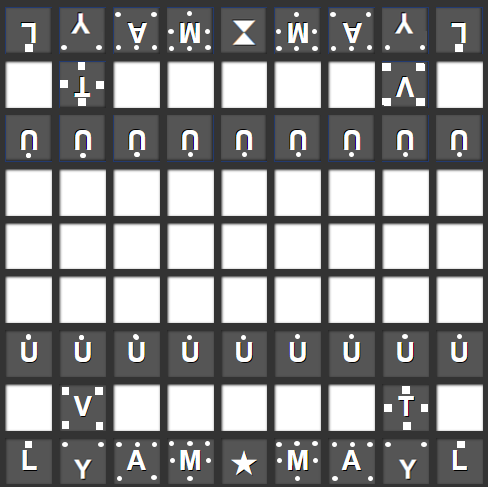
Basic Play for SHOWGIT
Players take turns to move a piece that belongs to them. Each piece is moved according to different rules but no two pieces can occupy the same square. If a piece moves so that its final position is a square occupied by an opposing piece, the opposing piece is "captured" or "taken" and is removed from the board. Captured pieces should be placed face up within easy view of both players. On your turn, capturing an opponent's piece is not mandatory—you may choose to make a different move instead.
- STAR/TIME - moves one space in any direction diagonally or orthogonally.
- MIKE - moves one space in one of 6 directions - forwards, diagonally forwards, sideways or backwards.
- ALPHA - moves one space in one of 5 directions - forwards, diagonally forwards or diagonally backwards.
- YANKEE - moves two squares forwards and then one square sideways. It is the only piece that can jump over others.
- LIMA - moves any number of spaces forwards.
- TANGO - moves any number of spaces orthogonally but cannot jump over another piece.
- VICTOR - moves any number of spaces diagonally but cannot jump over another piece.
- UNIFORM - moves one square forwards only.
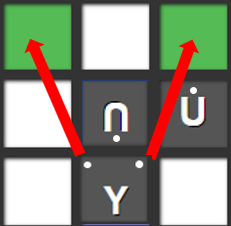
The directions in which a piece can move are indicated on the piece itself: a ● means it can move one square in that direction, and a ■ means it can move multiple squares.
Promotion
If a piece other than the MIKE or STAR/TIME makes a move that ends within the promotion zone (the last three rows), then the player can choose to promote that piece. The piece is turned over to reveal the symbol of the promoted piece. A piece that was dropped into the promotion zone can also be promoted when it is moved. You can choose whether or not to promote a piece, but if a UNIFORM or LIMA reaches the final row or the YANKEE reaches the penultimate row, then that piece MUST be promoted.
After promotion, the piece is referred to with "NEO" added to the beginning of its name.
- UNIFORM, LIMA, YANKEE & ALPHA – when promoted move exactly like a MIKE (called a NEO-UNIFORM, etc.)
- Promoted TANGO – moves like a TANGO but acquires the power to move a single square diagonally.
- Promoted VICTOR – moves like a VICTOR but acquires the power to move a single square orthogonally.
Drops
A player with one or more captured pieces can opt to drop a captured piece onto the board instead of moving at any point in the game. The dropped piece can be re-entered onto any vacant square with the following restrictions:
- Pieces drop in the un-promoted state although they can be promoted in subsequent moves. A drop counts as a single move.
- A piece cannot be dropped on a square from which it would never have a legal move (i.e. a UNIFORM on the last row or a YANKEE on either of the last two rows).
- A player cannot drop a UNIFORM onto a file (column) where there is already an un-promoted UNIFORM that belongs to the same player.
- A UNIFORM cannot be dropped in front of a STAR/TIME in such a way that it would cause the STAR/TIME to become BIG-BANG.
Finishing
BIG-BANG: When a piece is moved such that a player's STAR/TIME cannot avoid being captured upon the next turn, that player's STAR/TIME is said to be BIG-BANG and the game is over.
Repetition: If the same board position occurs four times with the same player to move, the game ends in a draw. However, if the repetition is clearly intended to avoid a BIG-BANG situation, the repeating player must be declared the loser.